From Research to Operational Technology: The DT4GS Legacy in navIQore
With DT4GS complete, three methods validated across its Living Labs — performance-deviation baselining, retrofit feasibility simulation, and predictive-maintenance anomaly detection — now exist in navIQore, though several are still delivered as ad-hoc, engineer-led analyses rather than fully self-service features.
- Context
- DT4GS
- Project
- DT4GS
With the completion of the EU-funded DT4GS project, several methods first developed and validated across its four Living Labs are now part of navIQore's own capabilities for vessel monitoring and performance analysis.
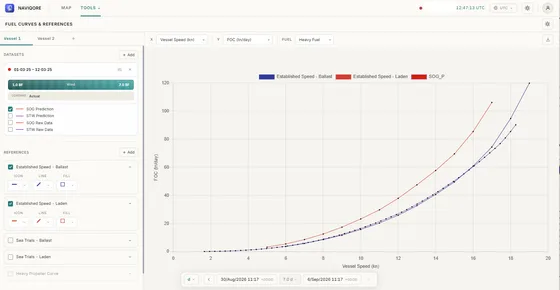
Performance-deviation baselining. On both the tanker and bulk-carrier Living Labs, Konnecta built an ISO 19030-based fuel-curves-and-reference model: a per-voyage speed-versus-fuel-consumption baseline, established from a reference voyage taken shortly after dry-docking, against which every subsequent voyage is compared to reveal hull- and propeller-fouling-driven consumption increases. Validated independently on two vessel types with consistent results, this baselining approach is the direct basis for the fuel-consumption curves and performance-reference models navIQore offers today.
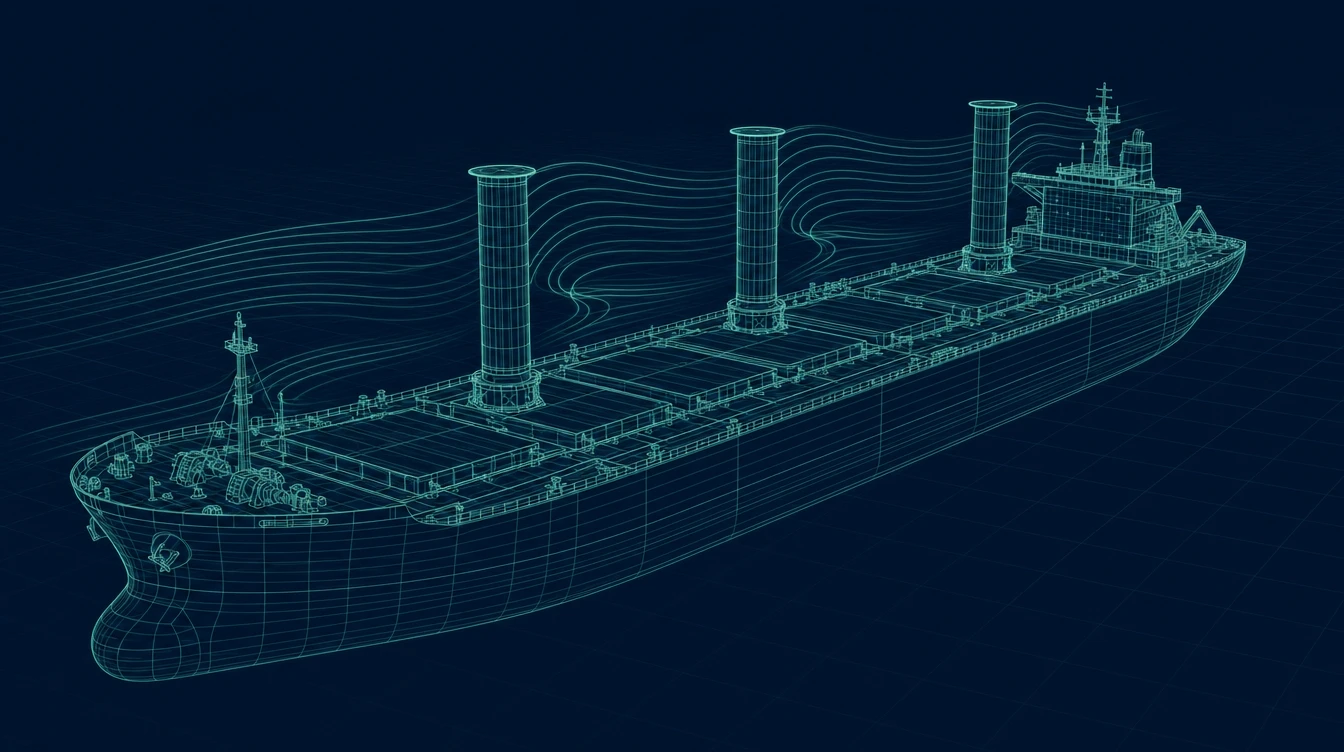
Retrofit feasibility simulation. A configurable wind-assisted-propulsion simulator — modelling Flettner-rotor configurations against a vessel's actual historical voyage and weather data — was built and run on both the tanker and bulk-carrier Living Labs, quantifying the fuel-saving potential (and, for some configurations, the drag penalty) of retrofitting rotor sails ahead of any physical investment. The same simulation approach exists in navIQore and has been applied to real retrofit-feasibility questions since.
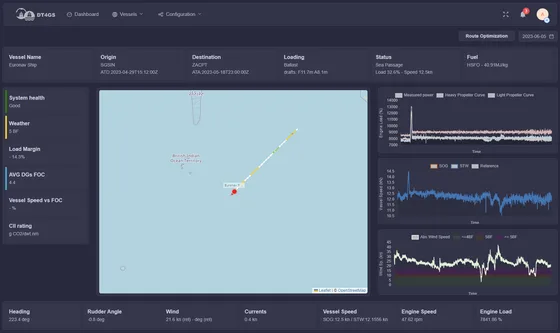
Anomaly and predictive-maintenance detection. Across the containership, ferry and bulk-carrier Living Labs, DT4GS validated methods for recognising early signs of machinery and hull degradation from operational data — from vibration and exhaust-temperature drift to hull-condition and biofouling indicators. These detection methods are available within navIQore and underpin its approach to flagging operational anomalies before they become failures.
All three capabilities exist in navIQore today. As with much of the platform's more advanced analysis, several of them are still delivered as ad-hoc, engineer-supported studies tailored to a specific vessel or question — an approach that started as EU-funded experimentation and has not yet been fully packaged into a standardised, self-service feature. That progression, from research prototype to ad-hoc analysis to productised capability, is itself part of navIQore's ongoing roadmap.