navIQore at TRA 2026: Extending Digital Twins to Inland Waterways
Konnecta presents 'A Digital Twin Platform for Automated and Zero-Emission Inland Waterway Operations' at TRA 2026, showing how navIQore extends from oceangoing vessel-performance assessment to inland-waterway mission planning — demonstrated on the Royal Opera House of Ghent construction-logistics case.
- Context
- TRA 2026
- Project
- FOREMAST
Konnecta presents the paper “A Digital Twin Platform for Automated and Zero-Emission Inland Waterway Operations” at TRA 2026, showing how navIQore is being extended from oceangoing vessel-performance assessment to the planning and operation of inland waterway transport. The paper is presented on Wednesday, 20 May 2026, during Technical Session 5 / Special Session 4, “Sustainable Waterborne Freight Systems” (Greening Freight Transport).
Developed through the EU-funded FOREMAST project, the extended platform brings together vessel and waterway data, domain knowledge and simulation models. It connects a semantic representation of the vessel with a digital twin of the waterway network, allowing routes to be evaluated against practical constraints such as vessel dimensions, water depth, bridge clearances, locks and changing water levels.
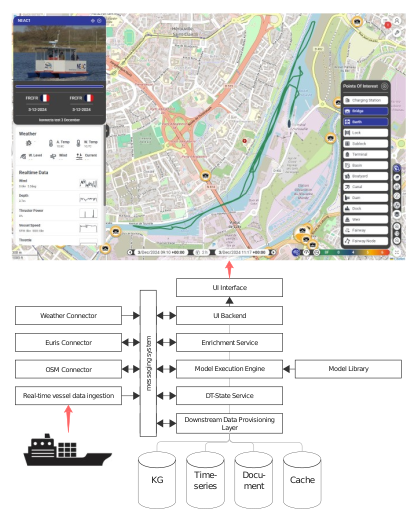
Within this common environment, navIQore orchestrates models for route feasibility, cargo loading and stability, energy and emissions forecasting, vessel manoeuvring and platooning, and multimodal logistics. This supports both advance mission planning and adaptive operation using live vessel, weather, current and infrastructure data.
The approach was applied to the renovation of the Royal Opera House in Ghent, a demanding urban construction-logistics scenario involving restricted waterways, multiple waste and material flows and limited road access. The digital twin was used to compare vessel configurations, loading plans, routes and multimodal transport options before execution.
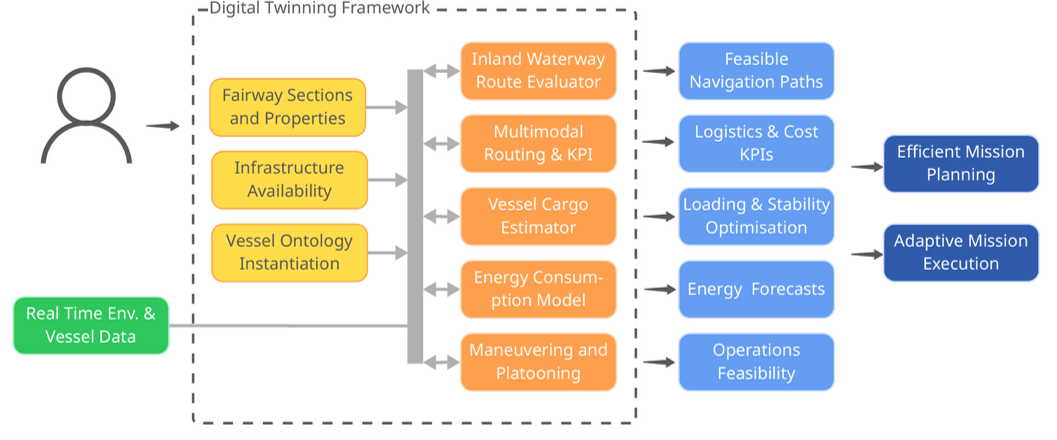
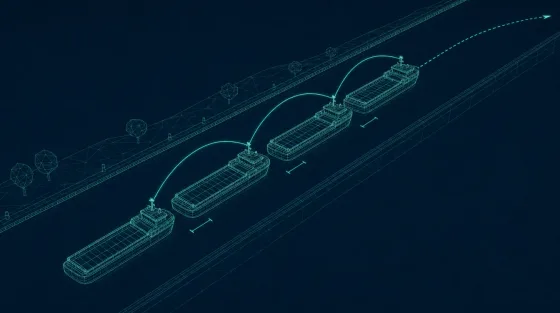
The analysis demonstrated that the best solution depends on the route and cargo flow. Automated platoons reduced the number of trips and operating time for high-volume transport, while individual vessels were more suitable for smaller flows. The simulations also quantified the strong influence of current and wind on battery margins and identified where battery swapping could enable circular logistics without empty return journeys.
This work demonstrates how navIQore can evolve beyond vessel monitoring into an integrated decision-support environment for planning efficient, low-emission inland missions. Its modular architecture also provides a transferable foundation for deploying Small, Flexible, Automated and Zero-emission vessels across other urban, rural and industrial waterways.