FOREMAST: Extending navIQore to Inland-Waterway Digital Twins
With the launch of the EU-funded FOREMAST project, Konnecta begins extending navIQore's digital-twin architecture beyond deep-sea shipping into inland-waterway and autonomous-vessel operation, integrating data from Living Labs in Belgium and France.
- Context
- FOREMAST
- Project
- FOREMAST
Konnecta joins FOREMAST (foremast.eu), a three-year Horizon Europe project running from January 2024, as the partner responsible for extending navIQore's vessel digital-twin architecture into inland-waterway transport (IWT) and autonomous-vessel operation — a domain the platform has not previously addressed. Where DT4GS validated navIQore across deep-sea tanker, container, ferry and bulk-carrier operations, FOREMAST is expected to prove the same approach on smaller, more automated inland vessels, under Konnecta's technical lead for the project's vessel digital-twin work.
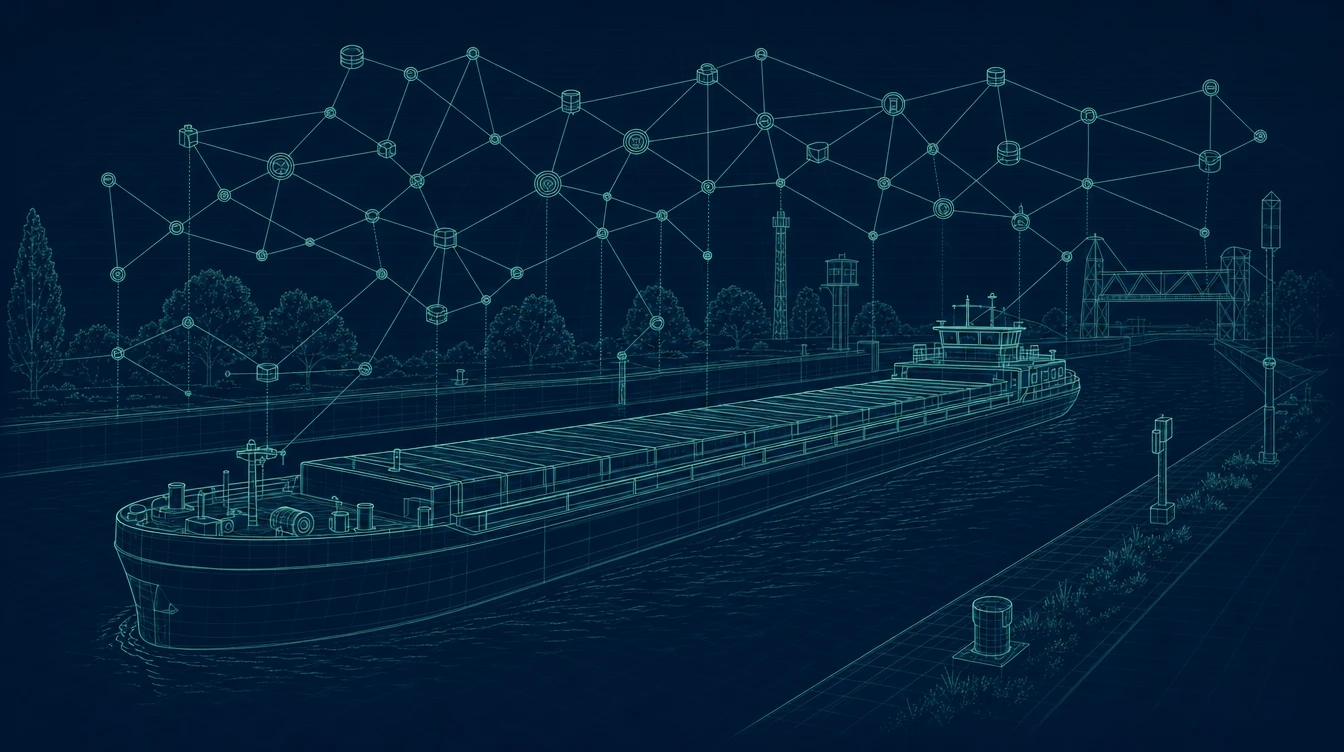
The work is structured around three Living Labs. The first, based in Ghent, Belgium, will integrate a fleet of AVATAR inland vessels equipped with onboard control systems, with navIQore's pipeline extended to receive real-time vessel-state data and, in the platform's most ambitious integration to date, feed computed actuation commands back to a following vessel — the technical foundation for vessel platooning. The second Living Lab, in Caen, France, will bring data from NEAC inland vessels into navIQore's data model, mapping onboard measurements onto the platform's existing variable catalogue so the same ingestion, storage and visualisation stack built for deep-sea vessels can serve an inland fleet with no purpose-built rework. A third, virtual Living Lab is planned to demonstrate that the resulting models and tools transfer to a different inland-waterway context — the Danube corridor around Galați, Romania — without requiring a physical vessel deployment.
Beyond vessel integration, FOREMAST is expected to extend navIQore with a semantic layer describing vessels and waterway infrastructure as connected knowledge graphs, and with a family of planning and simulation models spanning network-level economics, multimodal traffic flow, and vessel-level route, cargo and manoeuvring behaviour — complemented by a virtual-vessel environment for testing scenarios before they are run on real waterways. Over the course of the project, this is intended to culminate in a live demonstration of closed-loop vessel-to-vessel coordination, with navIQore acting as the bridge between onboard control systems and shore-based decision support.
FOREMAST gives navIQore its first opportunity to prove that a platform built and validated for ocean-going shipping can extend, with the same core architecture, into inland and autonomous-vessel operation — a direction that fits directly into the platform's longer-term roadmap.