Cloud-Enabled Vessel Platooning with navIQore
Within FOREMAST, Konnecta's cloud data layer coordinates leader and follower vessels for automated platooning in Ghent — an authenticated, low-latency MQTT architecture now validated through simulation and an on-water command-and-feedback testing campaign, with the same infrastructure feeding into remote-operation use cases.
- Context
- FOREMAST
- Project
- FOREMAST
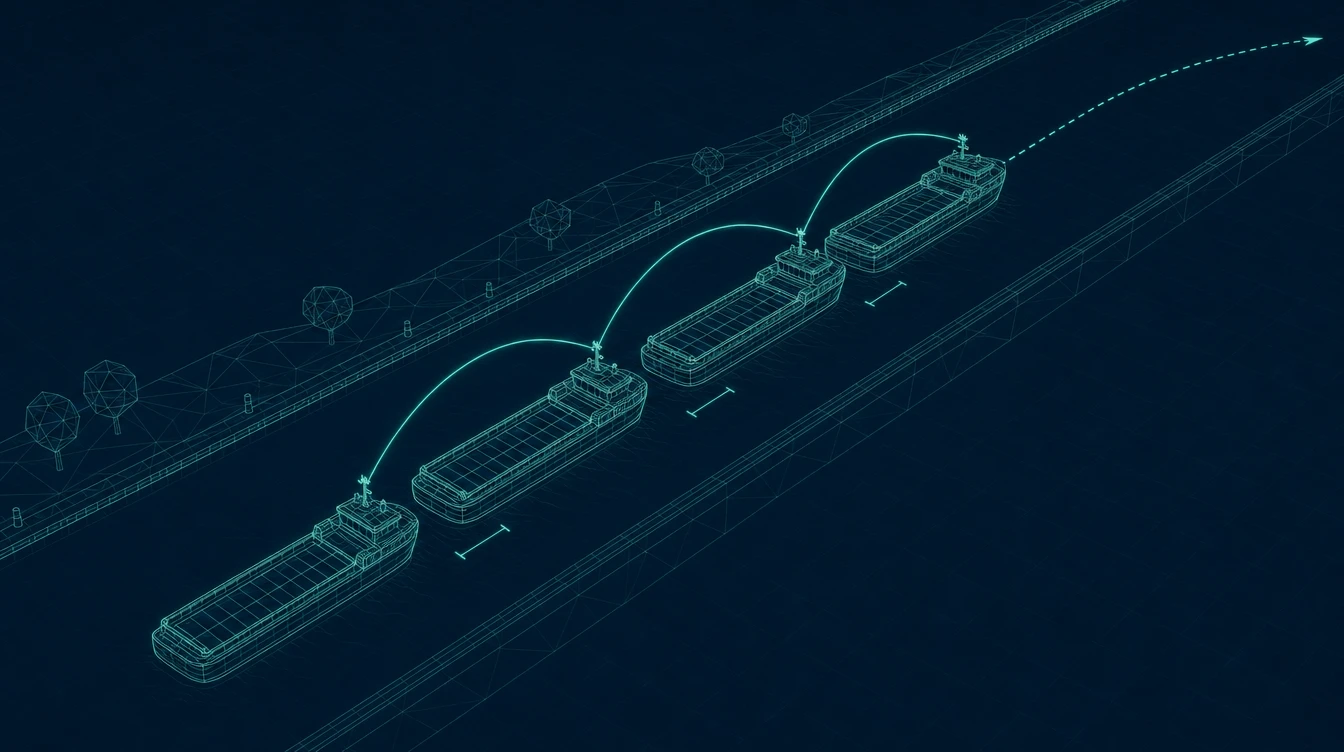
Within the EU-funded FOREMAST project, Konnecta's cloud data layer now underpins one of the project's most technically demanding integrations: automated vessel platooning on the waterways in and around Ghent, where a leader vessel and one or more automated followers hold formation under continuous shore-based oversight.
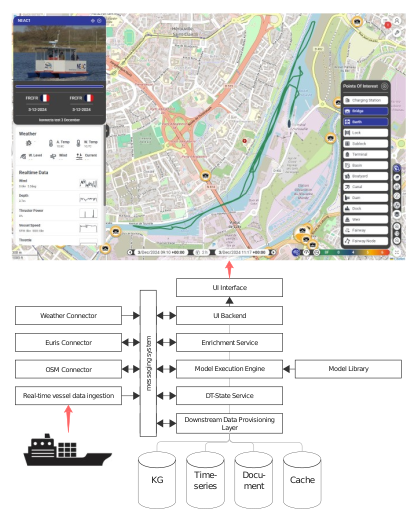
The architecture follows a distributed edge-control model. Onboard each AVATAR vessel, navigation state and propulsion feedback flow from the vessel's control interface, through a platooning control module, and are exchanged with the cloud over an authenticated, encrypted MQTT layer — TLS-secured, certificate-authenticated, and access-controlled at the topic level. On a follower vessel, the platooning control module uses the leader's reported position, and the position of any vessel ahead of it in the convoy, to compute the propeller-rate and rudder-angle commands needed to maintain formation, targeting end-to-end latency under 100 milliseconds and a 10 Hz update rate even under the connectivity constraints typical of maritime operation. The same cloud layer also receives propulsion feedback and commands from every vessel for monitoring, logging, performance analysis and diagnostics — extending navIQore's existing role as a fleet data layer into real-time, closed-loop coordination between vessels.
The underlying control logic steers each follower toward a look-ahead point along the leader's recent track rather than its instantaneous position, with a separate controller regulating inter-vessel spacing — an approach tuned and validated first through fast-time simulation across a range of manoeuvring and spacing scenarios, and then through an on-water testing campaign. That campaign began with dock and under-way "blink tests" — discrete, step-like commands used to validate the full command-and-feedback chain from a platform-issued command through to the vessel's actual response. Testing surfaced a genuine finding: an early test correctly transmitted a rudder command and produced real rudder movement, but the vessel's own reported feedback did not reliably track it — a fault traced to the rudder position sensor itself rather than the command chain, and resolved through sensor repair and recalibration before testing continued.
Beyond platooning, the same cloud coordination layer is expected to contribute directly to remote-operation use cases — linking vessel data, operational logic and shore-side services in a way that extends naturally from coordinating vessels with each other to coordinating a vessel with a remote operator.