Connecting Voyage Planning with Vessel-Performance Data
navIQore's voyage-planning tool brings route definition together with a vessel's own performance references, letting a planned voyage be evaluated for fuel consumption, duration and CII before it is sailed.
- Context
- Voyage Planner
navIQore's voyage-planning functionality brings route definition together with a vessel's own performance data, so a planned voyage can be evaluated in the same environment used for day-to-day monitoring rather than checked separately against generic tables.
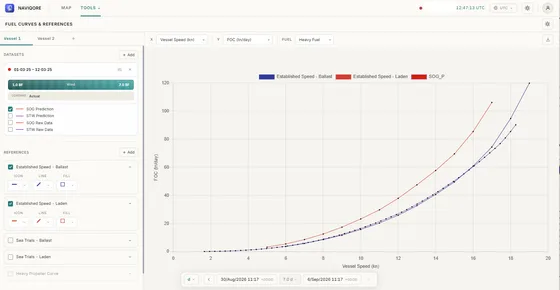
Planning starts from a reference: selecting a vessel and a historical period surfaces its base fuel consumption, base voyage duration, base average speed and base CII for that period, giving a concrete baseline to plan against. From there, a route is defined as a sequence of waypoints on the map, and the tool calculates the resulting distance, duration and required speed or power for the planned course.
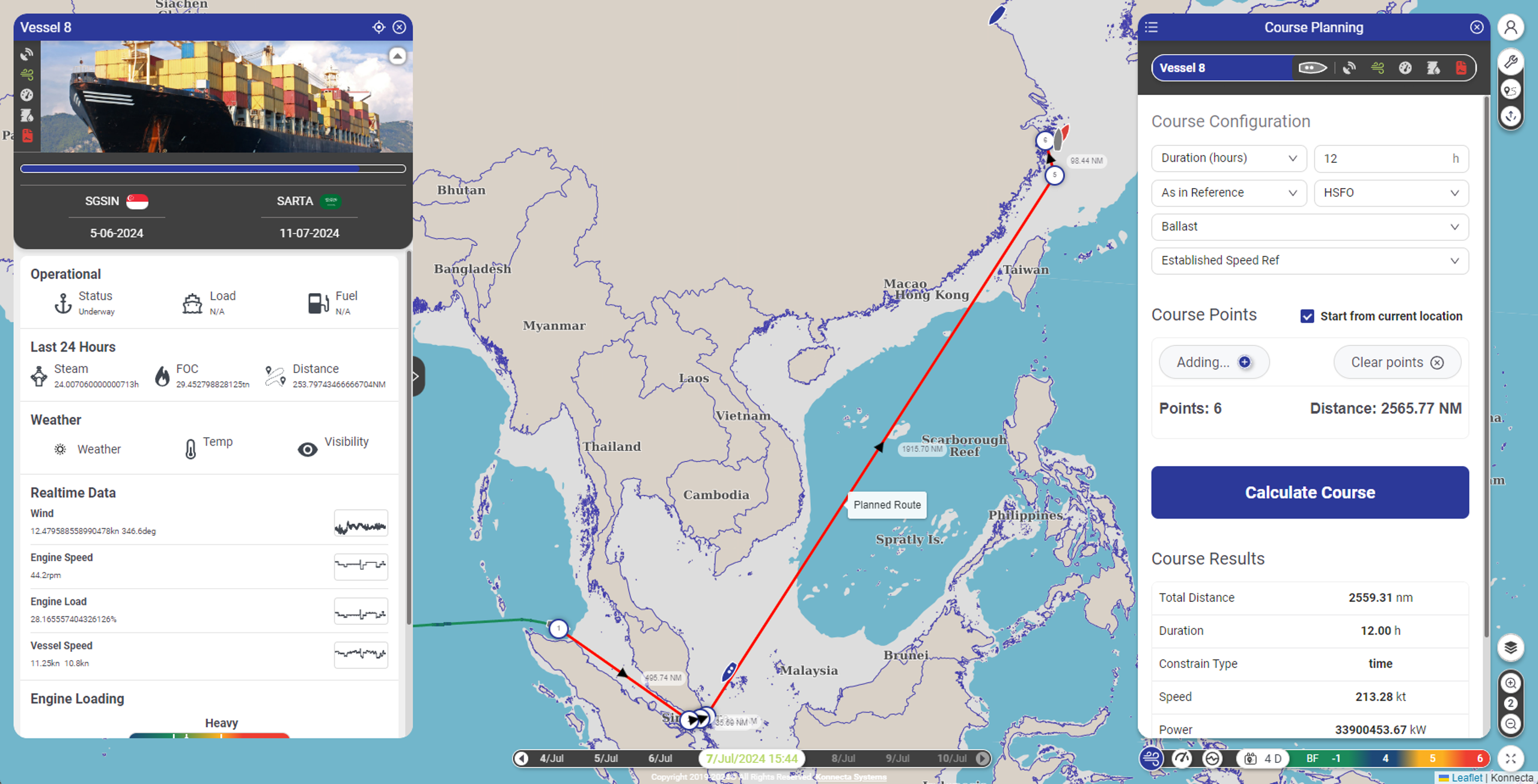
The scenario itself is configurable: the performance basis can be the vessel's actual observed performance, its chartering reference curve, a load-condition-specific reference, or a simulated profile; weather can be set to a specific sea state or drawn from actual historical conditions; and the voyage can be constrained to the same duration, the same average speed, a defined speed, or a defined duration as the reference voyage. The result is shown side by side with the base case — fuel consumption, duration, average speed and CII — so the operational effect of a decision is visible before it is made.
This makes the planner useful well beyond simple route drawing: evaluating a slow-steaming option, comparing performance across sea states, assessing an energy-saving retrofit before it is installed, or supporting a chartering or compliance decision with numbers grounded in the vessel's own historical performance rather than a generic estimate.