Improving Noon-Report Quality Through Automated Consistency Checks
navIQore TrueNoon applies automated checks before and after report submission to catch missing, implausible or internally inconsistent information — from a transparent fuel ROB ledger to speed-distance and cross-report consistency checks — while leaving professional judgement in the crew's hands.
- Context
- Data quality
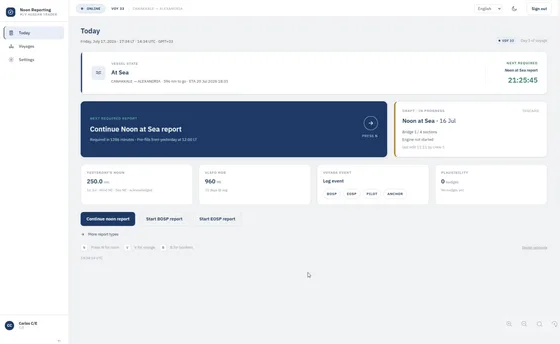
A noon report can contain hundreds of individual data points, entered by different departments, often under time pressure. Every value can look reasonable on its own and still contradict the fuel balance, the voyage figures, or the previous day's report. navIQore TrueNoon applies automated checks throughout report preparation and review to catch that kind of issue before the report is signed — not to replace professional judgement, but to give crews specific, immediate feedback while the operational context is still fresh.
The checks fall into two categories. Blocking completeness findings identify mandatory information — steaming hours, distance under way, main-engine load and counter readings, cargo information, and fuel consumption allocated across main engine, auxiliaries, boiler or another consumer — that must be resolved before normal sign-off, with the rules adapting to the report type so that, for example, a Beginning of Sea Passage report is not held to performance fields it does not contain. Plausibility warnings highlight information that deserves a second look without stopping the crew from saving, submitting or signing the report; an authorised override remains available for genuine operational exceptions, recorded explicitly rather than silently bypassed.
For fuel, TrueNoon calculates each grade's remaining-on-board quantity from a transparent ledger — previous ROB plus received quantity minus consumption equals new ROB — and flags a fuel difference greater than 0.5 metric tonnes between one report's closing balance and the next report's opening balance, with equivalent continuity checks for lubricants, fresh water, bilge and sludge. Reported speed is compared with the speed implied by distance and steaming time, with a plausibility warning raised if the two differ by more than 5%; where valid positions are available, a second check compares reported distance against the great-circle distance between consecutive positions, flagging a deviation greater than 10%. Cross-report checks catch a cumulative main-engine revolution counter that decreases rather than increases, and within a single report, an unusual combination of Beaufort force and swell height is flagged for review.
These are advisory signals, not verdicts — exceptional weather, routing, maintenance or a genuine operational condition can explain any of them, and the goal is to surface the discrepancy for a human to confirm, not to force data into an expected pattern. Once a report is signed it becomes immutable, and a second, independent layer of assurance applies ashore: TrueNoon verifies each signed report's digital signature and audit chain on arrival, confirming that what shore receives matches what the vessel actually signed.
Together, these two layers — onboard plausibility checks and shore-side integrity verification — move data-quality control from a delayed, shore-side clean-up exercise into a visible part of the vessel's everyday reporting workflow, with benefits that extend well beyond a single report: more consistent source data improves bunker tracking, voyage analysis, and every downstream calculation that depends on the noon-report record.